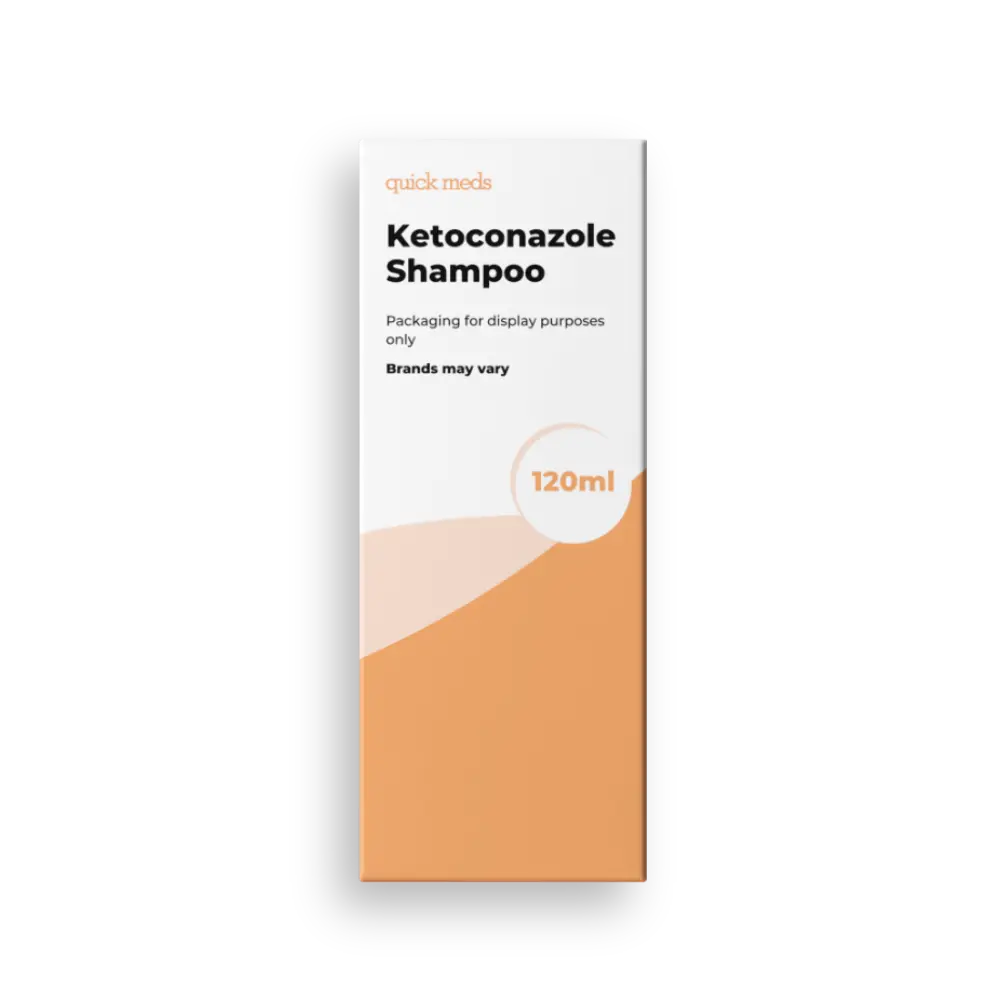
Ketoconazole Shampoo
What is Ketoconazole 2% Shampoo and How Does it Treat Seborrhoeic Dermatitis?
If you are dealing with a greasy scalp, an itchy or flaking scalp and visible scaling, you’re likely dealing with seborrhoeic dermatitis, which is more than just dandruff gone bad.
Seborrhoeic dermatitis is a chronic, inflammatory skin condition that targets areas like your scalp, eyebrows and the sides of the nose. These areas are known for producing the most oil (sebum).
When over-the-counter products fail, Ketoconazole 2% shampoo can be obtained on prescription from GPhC- registered providers such as Quick Meds.
The Science: How Ketoconazole Targets Malassezia Yeast
It all involves a harmless yeast called Malassezia. This is present on normal skin but is found in higher amounts in seborrhoeic dermatitis. In higher amounts, this yeast causes inflammation and all the symptoms associated with the condition:
Flaking skin
Patches of yellow greasy skin on red inflamed skin
Itchiness
Ketoconazole, as an antifungal, attacks the fungus, addressing overgrowth and therefore stopping the production of inflammatory byproducts.
Unlike standard shampoos, ketoconazole directly addresses the overgrowth of the malassezia fungus, eliminating the cause of symptoms outright.
Is Ketoconazole 2% Better Than Standard Anti-Dandruff Shampoos?
Standard anti-dandruff shampoos are designed for mild shedding - simple dry dandruff. These shampoos use milder agents, such as coal tar or dimethicone which temporarily wash away loose flakes.
These shampoos do not contain an antifungal ingredient and therefore do not have the clinical capability to reduce the malassezia fungus responsible for seborrhoeic dermatitis symptoms.
Results from clinical trials comparing ketoconazole against other shampoos consistently confirm the clinical superiority of ketoconazole.
Feature | Ketoconazole 2% Shampoo | Alternative Shampoos (Zinc, Coal tar, Salicylic acid) |
|---|---|---|
Mode of Action | Targeted antifungal | Mild antimicrobial, keratolytic or cytostatic |
Clinical efficacy | 73% improvement over 4 weeks | Coal tar - 67% improvement over 4 weeks |
Inflammation Control | Direct localised anti-inflammatory action | Minimal anti-inflammatory effect |
Recurrence Protection | Over 80% remain relapse-free at 6-months | Significantly higher recurrence rates |
Application frequency | Twice a week, reduced to once every 1-2 weeks for maintenance | Daily use |
How to Buy Ketoconazole 2% Online Safely via a GPhC-Registered Pharmacy
You can buy ketoconazole 2% shampoo online through our GPhC-registered online pharmacy. Simply fill out an online questionnaire - this will ask about your symptoms, your medical history and if you take any other medication.
Once you have placed your order, a clinician will review your responses for safety and appropriateness. Once approved, your order is dispatched, usually on the same day in plain, discrete packaging, with next day delivery options available.
How to Use Ketoconazole 2% Shampoo Correctly
Compared to your usual shampoo which you may use for everyday washing, Ketoconazole shampoo must be applied with clinical precision, to allow the active ingredient to work properly.
The golden rule is contact time. Ketoconazole must stay in contact with the scalp to penetrate the skin effectively and successfully break down the Malassezia yeast.
The shampoo should be used twice weekly for 2-4 weeks.
Step-by-Step Application Guide for Maximum Efficacy
Follow the below guide to ensure the active ingredient works to its best capability during each wash.
Pre-rinse - Rinse your hair thoroughly with lukewarm water. Do not use hot water as this can strip natural oils whilst further inflaming the skin.
Apply and Massage - Apply a generous amount of shampoo, using the fingers (but not fingernails) to massage directly into the scalp, focusing on areas with yellow scales or itching.
5-minute contact - Leave the lather undisturbed for at least 3-5 minutes. This is where the chemicals will start to work.
Rinse - Rinse the scalp thoroughly with clean, running water, ensuring no lather remains.
Treatment Phase vs. Maintenance Phase: Getting the Frequency Right
Seborrhoeic dermatitis is a chronic, relapsing condition, it cannot be completely cured but it can be managed effectively.
During active flare-ups, the treatment is used more often compared to the maintenance phase where it is used less often as a preventative strategy.
Flare-Up Treatment Phase
When you are actively experiencing thick yellow plaques, redness or itching daily, you are having a flare-up
Dose - Use the shampoo twice a week (e.g. Monday and Thursday)
Duration - Continue using the shampoo strictly for 2 to 4 weeks.
Importantly, do not use it everyday. This doesn’t clear symptoms faster but will strip the scalp’s natural oils, leading to dryness and irritation.
Maintenance Phase
Once the scalp is clear of scales, you must switch to the maintenance phase. The Malassezia yeast is always on the skin - if treatment stops completely, the yeast can grow back.
Dose - Use the shampoo once every 1 to 2 weeks.
This keeps the fungus at bay, preventing it from growing back to a level where it will cause inflammation again, leading to a flare-up.
What Happens If You Stop Using It Too Soon?
For those who stop using treatment as soon as the flakes disappear, they risk a relapse of symptoms.
Data from clinical trials show, when patients stop using the shampoo abruptly there is an almost 50% risk of relapse, with symptoms returning within one month.
For this reason, emphasis is placed on continuing to use the shampoo, less frequently, to keep the population of Malassezia at bay, preventing a relapse.
Who can use Ketoconazole 2% Shampoo?
Greasy, Yellow Flakes vs. Dry Scaling: Matching the Treatment to Your Scalp
Whilst an effective first-line therapy for seborrhoeic dermatitis, ketoconazole is not a solution for every type of flaky scalp.
Ketoconazole should be reserved for use when:
Flakes are greasy, oily and distinctly yellow
Form thick, stubborn plaques which stick to the skin
The scalp is red or inflamed
This indicates there is an inflammatory response to the overgrowth of the Malassezia yeast
Ketoconazole should not be used if:
Flakes are small, dry and bright white
Flakes shed easily, falling freely
The scalp shows no signs of inflammation
This indicates a dry scalp which is ineffectively moisturised.
Pregnancy, Breastfeeding, and Safety Considerations
The shampoo can safely be used in pregnancy as it is not systemically absorbed.
During breastfeeding, it is safe to continue using the shampoo as it does not pass into breastmilk. However, caution should be used upon application to ensure the product is never applied near the breasts to prevent accidental ingestion by the infant.
Additionally, hands should be washed thoroughly after applying.
Potential Side Effects and How to Avoid Scalp Irritation
Whilst it is safely tolerated by most skin types, ketoconazole may cause mild, localised side effects.
The most common side effects include:
Local skin dryness or slight burning sensation
Minor changes to hair texture - hair feeling dry
Uncommon side effects include:
Discoloured hair - particularly in individuals with chemically treated or bleached hair.
Contact irritation - if there is an underlying allergy to shampoo preservatives.
A serious allergic reaction is rare. If you experience swelling of the lips, mouth, throat or tongue, you struggle to breathe/swallow, you should seek immediate medical attention.
To minimise skin reactions, it is advised to:
Perform a patch test - if you have sensitive skin. Apply a small amount of shampoo at your neck, leaving for 3 minutes before washing off. Wait 24 hours to ensure no severe redness or burning develops
Protect the eyes - Tilt the head back when rinsing to prevent lather contacting the eyes.
Avoid hot water - always use lukewarm water to minimise inflammation and itching
Ketoconazole vs. Alternative Medicated Shampoos
Ketoconazole shampoo is not the only product marketed to help treat seborrhoeic dermatitis. So which one should you choose? Common products are highlighted below.
Active Ingredient | Primary Action | Best suited for |
|---|---|---|
Ketoconazole 2% (Nizoral) | Anti-fungal and anti-inflammatory action | First-line treatment for seborrhoeic dermatitis. |
Selenium sulphide (Selsun) | Antifungal and cytostatic (slows skin cell turnover) | Stubborn flaking not responding to ketoconazole. |
Coal Tar (Neutrogena T/Gel) | Anti-inflammatory and anti-itch | Intense itching |
Salicylic Acid (Capasal) | Breaks down and removes stuck-down scales | Initial treatment used to clear away thick scales before using an antifungal |
When a Medicated Shampoo Isn’t Enough: When to Escalate Treatment
Whilst an effective treatment, it's important to recognise when the shampoo isn’t enough. Following several weeks of correct use, if ketoconazole shampoo does not relieve symptoms, this may require more targeted prescription interventions.
If you experience any of the following symptoms, you should seek medical advice:
Significant redness. If redness spreads to the whole scalp, as angry red plaques spread to the forehead or neck.
Weeping and crusting.
Bacterial infection. Swelling, tenderness, pain, pus-filled blisters or golden-crusting.
Hair shedding.
A healthcare professional can provide targeted treatments if needed, such as steroid creams, an antifungal cream or in severe cases, refer to a dermatologist.
Frequently Asked Questions
Everything you need to know
Can I use my regular conditioner after using Ketoconazole 2% shampoo?+−
Yes, you can but only apply it to the ends of the hair, avoiding the scalp. Standard conditioners can leave behind oils that feed the yeast, offsetting the benefits of treatment.
Will Ketoconazole shampoo cause my hair to fall out?+−
No, the treatment does not cause hair loss. Severe seborrhoeic dermatitis may itself cause temporary hair shedding due to inflammation clogging hair follicles.
Ketoconazole, by clearing the fungal overgrowth can reduce inflammation supporting a healthy scalp and healthy hair growth.
How long does it take for Ketoconazole shampoo to work? +−
Most people see a noticeable improvement within 1 to 2 weeks of consistent use.
However, even if symptoms clear up, it's important to continue using treatment for the full 2-4 weeks to completely bring the yeast population under control. This is then followed by a reduced maintenance use every 1-2 weeks.
Why is my scalp still itchy after using Ketoconazole shampoo? +−
If your scalp is still itchy, this is usually because the skin is still inflamed and healing.
If itching persists after 4 weeks, you may require a more targeted treatment, or you may be dealing with a dry scalp rather than a fungal overgrowth. Consult a healthcare professional to re-evaluate your symptoms.