Scabies treatments
Showing 2 of 2

Frequently Asked Questions
Everything you need to know
What is scabies?+−
Scabies is a common and highly treatable skin condition caused by microscopic mites (Sarcoptes scabiei) burrowing into the outer layer of your skin.
This triggers an allergic immune response leading to intense itching at night and a noticeable rash. It is a normal medical issue and is completely unrelated to personal hygiene or cleanliness.
What does scabies look like?+−
Classic scabies presents with small, raised red spots, bumps, or pimple-like lesions. In some cases, you can see the scabies burrows, which appear as very fine, wavy grey or silvery lines on the skin surface.
The rash is typically found in warm skin folds like the finger webs, wrists, armpits, and waistline.
What are the first signs of scabies?+−
An intense, persistent skin itch that becomes dramatically worse at night.
If it is your first time catching scabies, this early symptom can take three to six weeks to appear. If you have had it before, your immune system reacts much faster, and early scabies symptoms can flare up within a few days.
How do you catch scabies?+−
Through direct, prolonged skin-to-skin contact with an infested person, such as holding hands, sleeping in the same bed, or through sexual contact.
Brief physical contact, like a quick handshake or a hug, is highly unlikely to spread the mites. What causes scabies is the live mites moving from one warm body to another.
Is scabies contagious, and for how long?+−
Yes, scabies is highly contagious.
You are contagious from the moment you catch the mites until you have completely finished your first full application of an effective treatment.
Can you buy scabies treatment without a prescription in the UK?+−
Yes. Permethin cream (Lyclear Dermal Cream) and Malathion (Derbac-M) liquid are pharmacy-only medicines. Whilst you don’t need a prescription, you’ll still need to answer a few questions, ensuring treatment is appropriate.
How do you use permethrin 5% cream (Lyclear) for scabies?+−
The cream is applied to cool, dry skin on the entire body from the neck down. The cream should be left on for 8-12 hours (overnight) following which it is washed off completely in a warm bath or shower.
The treatment is repeated exactly 7 days later.
How many times can you apply permethrin?+−
Permethrin should be applied twice, exactly 7 days apart.
Do not use it every day - this will not improve effectiveness but will lead to skin irritation, dryness and irritation.
How long does permethrin take to work?+−
Permethrin starts to work within hours of your very first application, killing the mites causing the infestation.
Why am I still itching after scabies treatment?+−
A post-treatment itch ( post scabies syndrome) is normal and does not mean your treatment has failed.
This is a sign the body is continuing to react to debris of dead mites, eggs and waste trapped under your skin. This lasts for 2-4 weeks until your skin naturally flakes off and regenerates.
If you notice new spots or burrow lines after week 4, you should seek further medical advice.
How long does scabies last?+−
Left untreated, scabies will never go away on its own.
With a correct, two-dose treatment course, the live mites are successfully cleared by the second week, though your skin will take a few additional weeks to fully stop itching.
Does everyone in the house need treatment?+−
Yes. All household members, sexual partners, and close physical contacts must apply the treatment on the exact same day, even if they have absolutely no symptoms.
Because the mites spread silently before causing symptoms, failing to treat everyone simultaneously is the number one cause of immediate reinfection.
What should I do about bedding and clothes?+−
Bedding and clothes should be washed on the same day you first apply treatment. Wash at 60°C or higher and tumble-dry them on hot.
Items that cannot be washed should be sealed tightly in a plastic bag for up to 3 days - without human skin contact, the mites cannot survive.
When should I see a doctor instead of self-treating?+−
If you are immunocompromised, showing signs of skin infection or notice widespread, thick, scaly crusts (crusted scabies), you should speak to your GP.
What can be mistaken for scabies?+−
Conditions such as eczema, hives, bed bug bites and folliculitis can all be mistaken for scabies, as they all share similar symptoms.
The only exception is distinct silvery-grey burrow lines and an itch that's worse at night - this is the most reliable indicator of scabies.
Scabies: Symptoms, Treatment and How to Get Rid of It
Scabies is a common skin condition caused by tiny mites that burrow into the outer layer of the skin. It can cause intense itching, particularly at night, alongside a rash that commonly appears between the fingers, around the wrists, waistline and other skin folds.
Cases of scabies have been rising across the UK and although it’s highly contagious, it’s usually straightforward to treat. In the UK, effective treatments such as permethrin (Lyclear) cream can be supplied online by Quick Meds. Although a prescription isn’t needed, a quick assessment helps determine suitability.
Scabies can affect anyone, regardless of age, lifestyle or cleanliness, it is not caused by poor hygiene. Early treatment can help relieve symptoms and reduce the risk of spreading the infestation to others.
What is Scabies?
Scabies is an itchy skin infestation caused by a microscopic mite called Sarcoptes scabiei var. hominis. The mites burrow into the outer layer of the skin where they live, lay eggs and trigger an allergic immune reaction.
Why is scabies so itchy?
The intense symptoms of scabies are not caused directly by the mites biting you. Instead, your body’s immune system is reacting to the physical presence of the mites, their eggs, and their waste products inside the skin.
This allergic response is what creates the severe itching and rash. Because it is an immune reaction, it has two unique features you should expect:
The delayed itch: If it’s your first time catching scabies, it can take up to six weeks for the itch to actually start, even though the mites are already there.
The post-treatment itch: Once you successfully treat scabies and kill the mites, their harmless waste remains in the skin until it naturally flakes off. Because of this, the allergic itching can stubbornly continue for up to four weeks after successful treatment.
Without effective medical treatment, scabies will not go away on their own because the mites will continue their life cycle indefinitely within the skin.
Is Scabies a Sign of Poor Hygiene?
No. Scabies is completely unrelated to personal hygiene, cleanliness, or how often you wash.
The condition is a common medical issue that affects people of all ages, lifestyles, and backgrounds worldwide.
It spreads through direct, prolonged, skin-to-skin contact with an infested person, meaning the mite simply moves from one warm body to another. Unfortunately, a social stigma still surrounds it, but catching scabies is no more a sign of poor hygiene than catching a common cold or head lice.
What Does Scabies Look Like, and what are the first signs ?
The main signs of scabies are an intense itch that worsens significantly at night, a widespread pimple-like rash, and tiny, silvery-grey burrow lines. Early scabies symptoms can take three to six weeks to appear if you have never had it before, but can develop within a few days if you are being re-infected.
Early signs vs an established rash
If it is your first exposure: Initially, you won't feel anything. The mites live and lay eggs silently for three to six weeks while your immune system slowly becomes sensitised. The very first signs are usually a mild, vague itch that steadily escalates.
If you have had scabies before: Your immune system recognizes the mite instantly. The intense itching and early scabies rash can flare up within one to three days.
As the infestation establishes, the classic scabies rash develops into small, raised red spots or fluid-filled bumps. Because itching is severe, scratch marks and crusted skin are very common, which can unfortunately risk a secondary bacterial skin infection if the skin breaks.
Where does the scabies rash usually appear ?
Scabies mites prefer warm skin folds and areas where clothing fits tightly. Look for the rash and silver burrow lines which look like tiny, wavy pencil marks under the skin in these specific zones:
In adults and older children: Webbed spaces between the fingers or toes, wrists, elbows, armpits, around the waistline, buttocks, and the genital area.
In babies, young children, and the elderly: The distribution can be much more widespread, frequently appearing on the face, neck, scalp, palms of the hands, and soles of the feet.
How do you get scabies, and is it contagious?
Scabies is highly contagious and is caught primarily through prolonged, direct skin-to-skin contact with an infected person. It is commonly spread through:
Sharing a bed
Holding hands
Sexual contact.
Whilst less likely, it can also be spread through:
Contaminated clothing
Towels
Bedding.
How long are you contagious?
You are contagious from the moment you catch the mites until your first full treatment application has been completed. You can therefore spread scabies for weeks before you even realise you have it.
Who needs to be treated at the same time?
As the mites spread so easily before symptoms appear, all household members, sexual partners, and close physical contacts must be treated at the same time, even if they do not have any itching or rash.
If you don't treat everyone simultaneously, you risk passing the mites back and forth in a "ping-pong" cycle of re-infection.
How Do You Treat Scabies?
Scabies is easily treatable using a specialised cream applied to the whole body, and in the UK, you can buy this treatment directly from Quick Meds pharmacy without a prescription.
Our GPhC-registered clinical pharmacy team can supply the treatment online after a quick safety check.
The first-line standard treatment is permethrin 5% cream (also branded as Lyclear Dermal Cream). As a pharmacy (P) medicine, you do not need to see a GP or get a doctor's prescription, though a pharmacist still needs to ask a few questions.
Alternative treatments may be considered where permethrin is unsuitable or has not been effective.
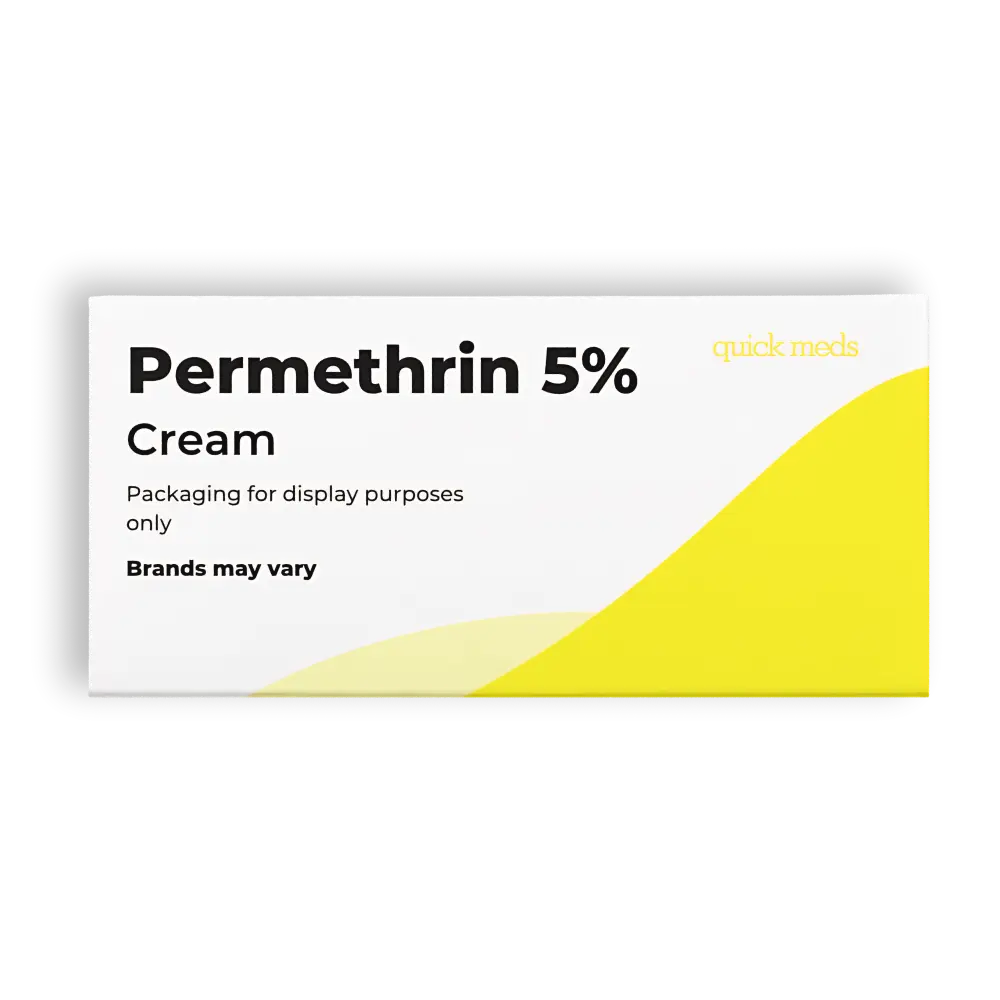
Permethrin 5% Cream (Lyclear Dermal Cream)
Permethrin 5% cream is the most common and effective treatment for uncomplicated scabies. It belongs to a group of medicines called pyrethroids, which work by targeting and disrupting the nervous system of the scabies mites, killing them quickly.
Because it is available over the counter, you can buy it today to start clearing your infestation immediately, without waiting for a doctor's appointment. It is suitable for most adults and babies over two months old.
Malathion 0.5% (Derbac-M)
If you’re allergic to permethrin, or if it hasn't worked for you, our pharmacists may recommend Malathion 0.5% liquid.
Like permethrin, Malathion is an over-the-counter Pharmacy (P) medicine that kills both mites and eggs. It serves as a highly reliable alternative, but it has a different application routine. It must be left on clean, dry skin for 24 hours before being washed off, and must also be repeated 7 days later.
When are oral tablets used?
In more severe cases such as "crusted scabies," if you are living with a severely compromised immune system, or if multiple rounds of prescription-free creams have completely failed a doctor may prescribe a medication called Ivermectin.
Unlike the creams, Ivermectin is a prescription-only medicine (POM) that comes in tablet form. It can only be given after a formal consultation with a GP, dermatologist, or online clinic, and is never available to purchase directly over the counter.
How long does it take for the itching to stop?
It is incredibly important to manage your expectations here: successful treatment does not mean instant relief.
Because the intense itch is an allergic reaction to the waste products left behind by the mites under your skin, the itching can routinely last for 2 to 4 weeks after the mites are dead.
This is completely normal and is known as a "post-scabetic itch." It does not mean the treatment failed, and it is not a sign that you need to reapply the cream immediately. Our team at Quick Meds can recommend soothing creams or antihistamine tablets to help you manage this while your skin naturally heals.
How Do You Apply Permethrin Cream Correctly?
To apply permethrin cream:
Rub it into cool, dry skin over your entire body from the neck down
Leave it on for 8 to 12 hours (usually overnight)
Then wash it off completely.
For the treatment to be successful, you must repeat this exact process exactly seven days later to kill any newly hatched mites.
Prep your skin: Skin must be cool and dry.
Do not apply the cream immediately after a hot bath or shower, as this causes excessive absorption. To be effective, the treatment needs to stay on the skin surface where mites live.
Wait until your skin is completely cool. Trim your fingernails short, as mites love to hide underneath them.
Apply meticulously from the neck down: Pay attention to hidden areas.
Massage the cream thoroughly into every single skin fold. You must explicitly cover the spaces between your fingers and toes, under your nails, your armpits, your belly button, and your genital area.
For babies, the elderly, or those with weakened immune systems, you must also apply the cream to the neck, face, scalp, and ears (avoiding the eyes and mouth).
Wait and dress: Can you wear clothes?.
Yes, you can get dressed immediately after applying the cream. Once it has dried (which takes just a few minutes), put on clean, loose-fitting clothing.
Avoid tight outfits that might rub the cream away.
The 12-hour rule: What if you wash your hands?
Leave the cream on for 8 to 12 hours.
Crucial rule: If you wash your hands with soap and water at any point during this treatment window (such as after using the toilet or washing dishes), you must immediately reapply the cream to your hands.
Wash off completely: Do not leave it on too long.
After 12 hours, take a warm shower or bath to wash the cream off completely. Do not leave the cream on for longer than 24 hours, as this will cause severe irritation, redness and chemical dryness, without killing more mites.
How many times do you need to use permethrin cream?
You need exactly two applications, exactly 7 days apart.
A single application will kill all living mites, but it does not reliably kill the unhatched eggs.
The second application a week later is mandatory because it catches and eliminates the newly hatched mites before they have a chance to mature and lay more eggs.
Skipping the second week is the most common reason people find themselves trapped in a cycle of reinfection.
What Should You Do About Bedding, Clothing and Towels?
On the very first day you apply your treatment, wash all bedding, towels, and clothing worn in the past three days at 60°C or higher and tumble-dry them hot to destroy any stray mites.
Any items that cannot be washed should be sealed in a plastic bag and left untouched for at least 72 hours, as scabies mites cannot survive away from human skin for longer than three days.
The golden rule of decontamination
You must treat all close contacts and launder all bedding/clothing on the exact same day. If you wash your sheets but a family member waits until tomorrow to apply their cream, you will simply pass the mites back and forth and re-infect each other.
Do you need to deep clean your house?
No, as the mites depend on the warmth of human skin to survive, there’s no need to deep clean your home. The mites cannot jump, fly or live in furniture/carpets like bedbugs.
While deep cleaning can provide extra peace of mind, aggressive cleaning measures are unnecessary. Focus on cleaning things that directly touch your bare skin: sheets, pillowcases, underwear, towels, and pyjamas.
Can you catch scabies again?
Yes. Having scabies once does not give you any long-term immunity. If you come into close physical contact with someone who has an active infestation, you can easily catch it again. This is why making sure all close contacts complete their two rounds of cream simultaneously is the single best way to prevent the infestation from returning.
Why Am I Still Itching After Scabies Treatment?
Itching for up to four weeks after completing treatment is completely normal and does not mean the medicine failed. This is known medically as post scabies syndrome.
It happens because your immune system continues to react to the dead mites, unhatched eggs, and waste trapped in your skin until it naturally flakes off. A mild emollient or over-the-counter antihistamines can be used to soothe the skin during this recovery phase.
How to tell if scabies are going away
It can be incredibly confusing to judge your recovery, but here is how you can spot the difference between your skin healing and a failed treatment:
Signs it is working: Intense night itching is gradually reducing and the old rash is starting to heal.
Signs it has not worked: Spots are still appearing, a new-spreading rash or new silver burrow lines appearing more than 2 weeks after your second dose.
When should you see a pharmacist or doctor?
You can consult our pharmacists at Quick Meds for routine scabies confirmation and over-the-counter treatment, but you must see a GP or seek urgent medical care if you:
Show signs of a secondary bacterial infection
Have a severely weakened immune system
Have suspect crusted scabies.
While highly stressful, a common anxiety is can scabies kill you? The answer is no, scabies mites are not life-threatening.
However, the severe complications of leaving it untreated, such as deep bacterial blood infections from broken skin, are why medical treatment is a priority.
Signs that need urgent medical care
You should contact a GP or NHS 111 immediately if you develop any of the following critical escalations:
Signs of a skin infection: Redness, swelling, yellow pus, weeping crusts, or you run a fever - bacteria have entered the skin and you may need prescription antibiotics.
Suspected crusted scabies: Also known as Norwegian scabies, this is a rare, severe form of the condition that typically affects older adults, people with neurological conditions, or those with weakened immune systems.
Unlike a standard infestation where a person only has around 10 to 15 mites on their entire body, crusted scabies involves thousands or millions of mites living in thick, widespread crusts and scaling on the skin.
Because it is overwhelmingly contagious and often does not cause the typical warning itch, it cannot be cured with over-the-counter creams alone, requiring immediate specialist supervision and prescription-only treatments like Ivermectin.
Conditions That Can Be Mistaken for Scabies
Several skin conditions can easily be mistaken for scabies because they share symptoms.
The single most reliable way to tell them apart is that scabies causes distinct, silvery-grey burrow lines under the skin, whereas lookalike conditions do not.
If you are trying to figure out what can be mistaken for scabies, look at the unique traits of these common lookalikes:
Eczema: When comparing scabies vs eczema, the main clue is moisture. Eczema typically causes extreme skin dryness, cracking, and scaling, and it usually settles in the creases of the elbows and knees. Its itch remains constant throughout the day, whereas a scabies itch peaks drastically at night.
Flea or Bed Bug Bites: These present as small, localized clusters of intensely itchy red bumps. Unlike a widespread scabies rash, insect bites often appear in a distinct straight line and are usually concentrated around the ankles or lower legs.
Hives (Urticaria): Hives look like raised, swollen welts or sting marks rather than tiny pimple-like bumps. They are unique because they appear very suddenly often due to an allergic trigger and can vanish or move to a completely different part of your body within 24 hours.
Folliculitis: This rash is caused by inflamed or infected hair follicles. You can identify it because every single red bump or tiny whitehead pustule is centered perfectly around a hair root, most commonly appearing on the thighs, buttocks, or chest.
If you are still uncertain about what is causing your rash, avoid applying harsh treatments blindly. Have a pharmacist or GP take a quick look in person to ensure you get the correct treatment for your specific condition.
How QuickMeds Can Help
Living with scabies can be incredibly stressful, uncomfortable, and isolating but you do not have to wait weeks for a GP appointment just to start your recovery. At Quick Meds, we are a GPhC-registered UK online pharmacy, and we provide a discreet, convenient way to access first-line standard treatment without unnecessary delays.
You can purchase permethrin 5% cream (Lyclear Dermal Cream) directly through our website. Simply complete a brief, confidential online questionnaire at checkout. Our qualified pharmacists will personally review your answers for safety and appropriateness dispatching in plain, discreet packaging.
We understand how much an active scabies scare can disrupt your daily life and peace of mind. That is why we focus on getting the clinically proven, first-line treatment into your hands as quickly and smoothly as possible with no long wait times or awkward face-to-face appointments.