Fully regulated UK pharmacy
Safe & clinically reviewed care
Rated 4.9/5 from over 3,000 reviews
Fast, discreet delivery
Fully regulated UK pharmacy
Safe & clinically reviewed care
Rated 4.9/5 from over 3,000 reviews
Fast, discreet delivery
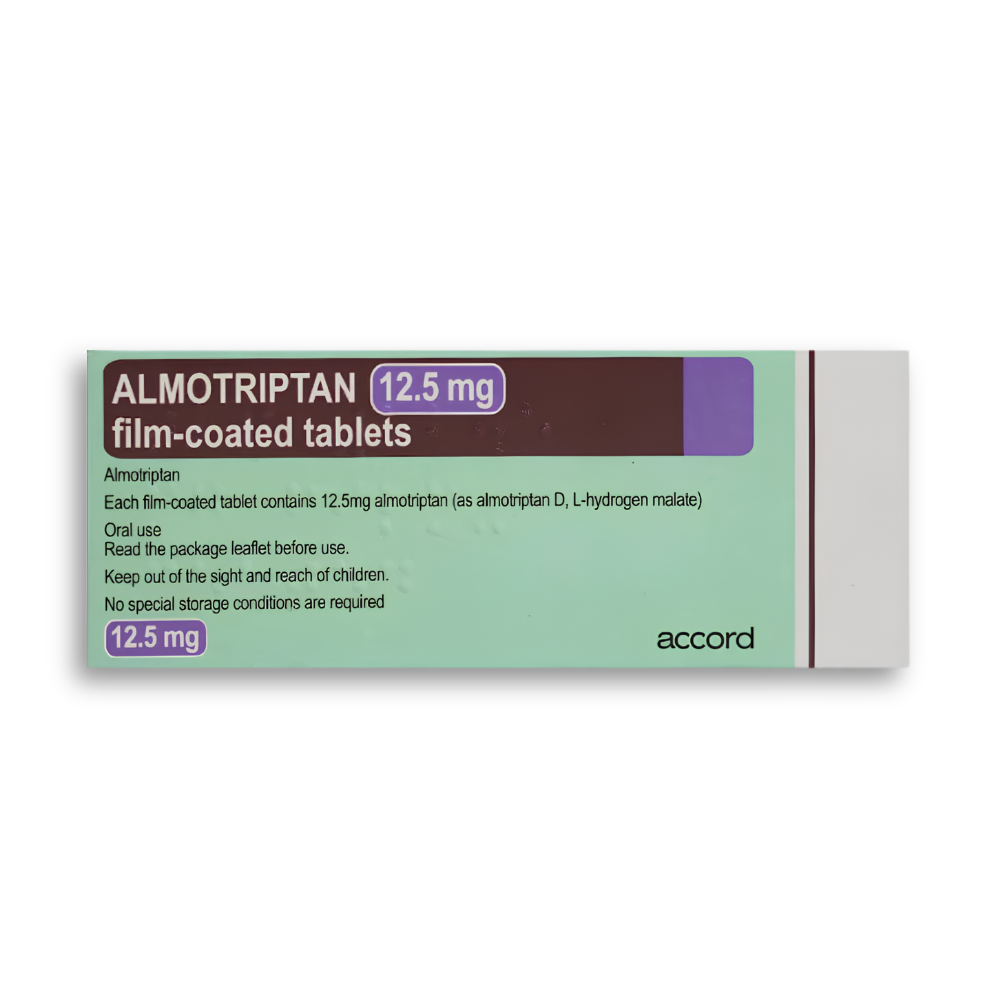
Migraines don't send calendar invites, they can strike during family dinners, meetings and long-awaited weekends - and when they do, relief can't wait. Almotriptan is designed for moments just like these.
Used for the treatment (and not prevention) of migraines, almotriptan is also available as the branded form, Almogran.
Both treatments can be obtained on private prescription from clinics such as Quick Meds, where our GPhC-registered pharmacists are on hand to ensure it is the right treatment for you.
As a prescription treatment, you need to fill out a short questionnaire which will ask a few questions about your health, ensuring the treatment is safe and effective for you.
To place an order:
Go to the Quick Meds website
From the Homepage, click on migraines
Click the orange ‘Start Consultation’ Button
Complete and submit the form
Add almotriptan tablets to your basket and checkout
Once your order has been submitted, our team of GPhC-registered pharmacists will check your details and confirm eligibility. Once approved, your order will be packaged discreetly, and dispatched for delivery as soon as the next day.
To understand how almotriptan works, it's important to first understand what a migraine is.
A migraine is a complex condition involving nerve impulses in the brain. It can be a whole-body experience affecting a person's ability to function normally.
During a migraine attack, blood vessels in the brain swell up, applying pressure on nerves. This is what can cause the symptoms of a migraine.
The main symptoms of a migraine include
A moderate to severe headache - described as a throbbing pain.
Unilateral pain - affecting only one side of the head (though it can affect both)
Sensitivity to light, sound and smells - known as photophobia, phonophobia and osmophobia.
Nausea and vomiting - feeling/being sick is a main thing which differentiates migraines from tension headaches.
Worsened by movement - walking, climbing stairs or moving your head can make the pain worse.
Some individuals may experience aura symptoms such as visual disturbances, sensory changes or speech problems.
A migraine has distinct stages, which may or may not include aura symptoms. These are prodrome - before the pain starts, the headache and postdrome (after the headache)
Whilst simple painkillers like paracetamol may help with the pain, we can now see, there's much more happening during a migraine. This is where migraine-specific medications, like almotriptan, are more appropriate.
Almotriptan belongs to a group of medicines known as selective serotonin receptor agonists or triptans.
During a migraine attack, its suggested blood vessels in the brain are temporarily widened. Triptans work by narrowing blood vessels and blocking the release of chemicals known to be involved in pain pathways.
Feature | Almotriptan 12.5mg tablets |
|---|---|
Product name | Almotriptan |
Legal status | Prescription only treatment |
Onset Time | Within 30 minutes |
Duration of Action | Up to 24 hours |
Available strengths | 12.5mg tablets |
Whilst it starts working within 30 minutes, its half-life is approximately 3.5 hours. This means the body clears the medicine fairly quickly, reducing the risk of side effects. For most users, a single dose may provide relief for up to 24 hours.
Almotriptan should only be used to treat active migraine attacks and not as a prevention treatment.
The recommended dose is one tablet, taken as early as possible once a migraine attack starts. If symptoms come back, a second tablet can be taken so long as there is a two-hour gap since taking the first dose.
The tablets should be swallowed whole with liquids and can be taken before or after meals. Food does not delay the tablet from working.
The maximum daily dose is two (12.5mg) tablets in any 24 hour period.
For patients who have severe kidney disease, no more than one tablet should be taken in any 24 hour period.
Whilst the tablets are generally safe for most people, they must not be taken by anyone who:
Is allergic to almotriptan or any of the tablet ingredients.
Has a history or current signs of ischemic heart disease.
Has severe (or uncontrolled) high blood pressure.
Has had a previous cerebrovascular accident, transient ischemic attack or peripheral vascular disease.
Is taking ergotamine, ergotamine derivatives, certain antidepressants or other triptans
If you are unsure if almotriptan is right for you, speak to the healthcare team at Quick Meds for personalised advice
As with all medication, almotriptan can cause side effects. For a full list, see the patient information leaflet.
In clinical trials, the most common side effects were mild to moderate and resolved on their own without treatment. They include:
Nausea
Dizziness/drowsiness
Tiredness
Less common side effects, affecting up to 1 in 100 people and include:
Diarrhoea
Dry mouth
Muscle pain
Bone pain
Paresthesia - tingling/burning/pins and needles
Chest pain
Data suggests almotriptan has a lower incidence of chest symptoms, including chest heaviness, pressure or tightness.
A head-to-head study comparing almotriptan to sumatriptan found chest pain occurred in 0.3% of participants taking almotriptan, compared to 2.2% in participants taking sumatriptan.
Serious side effects, whilst rare warrant immediate medical attention. They include:
An allergic reaction (anaphylaxis) - swelling of the face, tongue, lips or throat and difficulty breathing.
Cardiovascular events - such as signs of a heart attack, severe chest pain and shortness of breath.
Vision changes - such as blurred vision or sudden loss of sight.
Bowel symptoms - sudden severe stomach pain or bloody diarrhoea.
Serotonin syndrome - a life threatening condition if almotriptan is taken with certain antidepressants. Symptoms include confusion, a rapid heart rate, muscle stiffness and shivering.
Almotriptan isn’t suitable for everyone who suffers from headaches. Due to the complex nature of migraines, and how the treatment works, a clinical assessment is required to make sure the treatment is safe for you.
Almotriptan is indicated for treatment of a migraine in adults aged 18-65 years who have been clearly diagnosed with a migraine from a healthcare professional.
Although an effective treatment, almotriptan is not suitable for everyone. It must not be taken by:
The elderly - aged over 65 years.
Children - aged under 18 years.
Pregnant women - as there is not enough evidence to confirm it is safe.
Anyone who is allergic to almotriptan or other tablet ingredients.
Anyone who has or previously suffered from cardiovascular diseases that restrict blood supply to the heart such as:
Heart attack
Chest pain or discomfort that normally occurs with activity or stress
Heart problems without pain
Chest pain that occurs when resting
Very high blood pressure
Uncontrolled mild or moderate blood pressure
You have had a stroke or experienced a reduction in blood flow to the brain .
You have peripheral vascular disease.
You suffer from severe liver disease.
You are taking other medications used to treat migraines such as:
Ergotamine
Dihydroergotamine
Methysergide
Other triptans e.g. sumatriptan, rizatriptan
Certain antidepressants
Our clinical team at Quick Meds are optimally placed to provide tailored advice to anyone seeking treatment. As a GPhC-registered team, we only offer evidence based information to suit your treatment needs.
There is no single ‘best’ triptan. The effectiveness varies and one may work better for you than another. However, the differences between the treatments were studied and highlighted below:
Drug | Therapeutic gain (2h) | Main advantage | Key characteristic |
|---|---|---|---|
Sumatriptan (100mg) | 32% | The ‘gold standard’ | First generation drug |
Zomig (2.5mg) | 32% | Balanced profile | Better absorption than sumatriptan |
Rizatriptan (10mg) | 37% | Speed | Faster absorption |
Eletriptan (40mg) | 37% | High potency | Longer half-life |
Almotriptan (12.5mg) | 26% | Tolerability | Good safety profile |
Naratriptan (2.5mg) | 22% | Lower recurrence | Headache is less likely to return |
Frovatriptan (2.5mg) | 16% | Longest Half-life | Stays in the body longest |
Whilst medicines like rizatriptan offer higher therapeutic gain, this is usually at the cost of more intense side effects. Almotriptan offers an advantage in that it exhibits placebo-like safety.
Considered the best triptan for side effects, almotriptan suits individuals who are more prone to these undesired effects.
Everything you need to know
Yes, this is a common side effect of all triptans. However, almotriptan has a much lower incidence (0.3%) compared to other triptans like sumatriptan.
No, triptans should not be taken if you are pregnant.
If breastfeeding, it is advised to withhold breastfeeding for 24 hours after taking almotriptan
Most patients experience relief within 30 to 60 minutes. The medication reaches its peak concentration between 1.5 and 3 hours.
While both are effective treatments, clinical trials show almotriptan has fewer side effects, such as chest tightness, compared to sumatriptan.
If symptoms resolve but then return within 24 hours, you may take a second dose, so long as the second dose is taken 2 hours after the first dose.
No, almotriptan is a treatment designed to stop an active migraine. It does not work as a prevention. It should not be taken regularly.
One almotriptan tablet should be taken at the onset of migraine. If you get another migraine within 24 hours, you can take another tablet. However, these two doses must be at least 2 hours apart. You should not take another tablet for the same migraine.
You should generally avoid alcohol whilst taking almotriptan. Combining these may increase the risk of side effects such as drowsiness and dizziness, and alcohol itself is a common migraine trigger.
Aliysha Parveen
Add job title & qualification in Admin → Users